
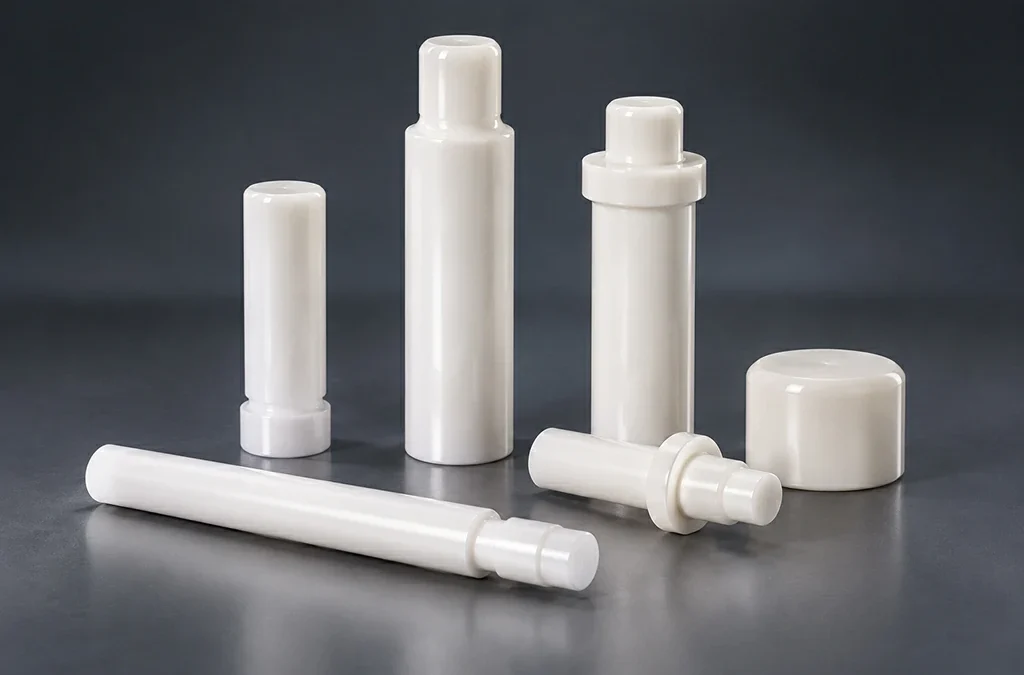
Zirconia ceramic (ZrO₂) materials can be processed into various types of demanding mechanical parts because they possess a series of decisive engineering advantages, including exceptional wear resistance, high mechanical strength, and superior high-temperature stability. Processed industrial zirconia ceramic pistons and plungers are widely used across global industries, serving as a reliable upgrade to conventional metal pistons.
1. High Hardness, Wear Resistance & Superior Metal Replacement
Due to the advanced production technology of zirconia ceramic pistons and the outstanding corrosion resistance of the ceramic material itself, precision-manufactured zirconia components pass rigorous corrosion resistance, acid resistance, and alkali resistance tests. With high surface hardness (Vickers hardness HV0.5 1,200 / HRA ≥ 90), wear resistance, and high-temperature capability, zirconia ceramic pistons serve as an ideal substitute for traditional metal pistons, ensuring reliable and stable performance throughout prolonged service life.
In high-pressure fluid environments where stainless steel or chrome-plated pistons suffer from micro-scoring and packing seal degradation, zirconia’s mirror-lapped surface finish (Ra ≤ 0.1 μm) reduces friction and extends seal longevity by 5 to 10 times.
2. High Mechanical Strength and Toughness in Engine & Machinery Components
Zirconia ceramic pistons have high mechanical strength (bending strength 800–1200 MPa) and significantly better fracture toughness (8–14 MPa·m1/2) than conventional technical ceramics. Consequently, zirconia ceramics are widely utilized to manufacture critical engine and machinery components, such as connecting rods, bearing cylinder liners, zirconia ceramic piston caps, and fluid plungers. High-profile automotive and heavy manufacturing industries utilize these high-performance ceramic engine parts to withstand cyclic mechanical shock.
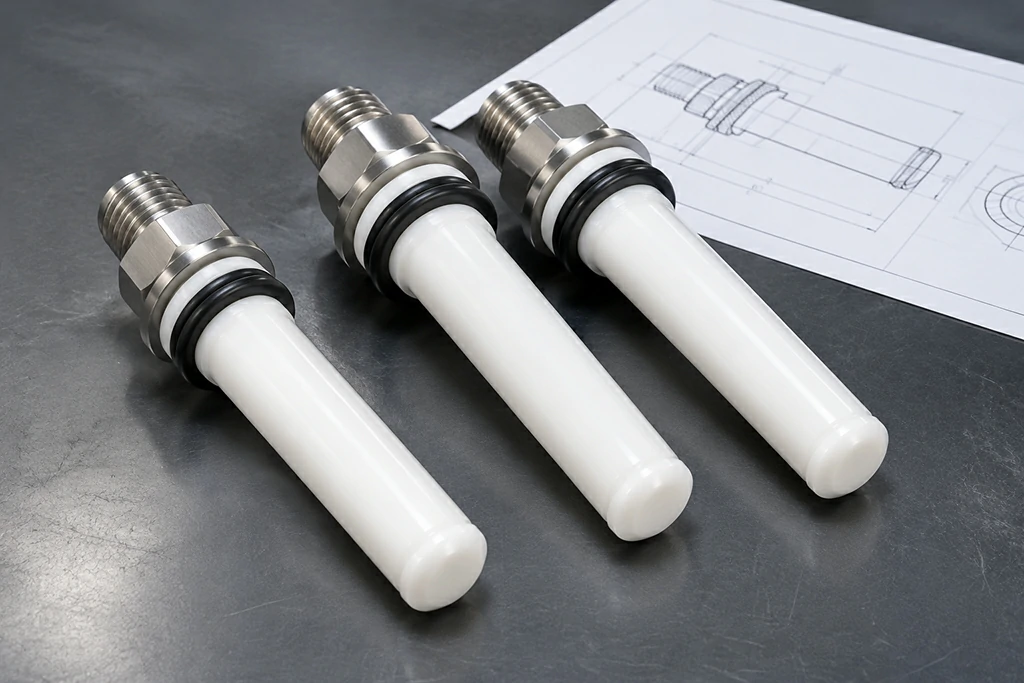
3. Unique Semiconductor & High-Temperature Sensor Properties
Zirconia ceramic pistons and components also possess unique functional semiconductor and electrical properties at elevated temperatures. High-temperature Solid Oxide Fuel Cell (SOFC) solid electrolyte membranes and oxygen concentration sensors in industrial gas and automotive exhaust systems are manufactured utilizing zirconia’s selective oxygen ion (O2-) conductivity at high temperatures.
At ambient temperatures, zirconia acts as an outstanding dielectric insulator with volume resistivity >1013 Ω·cm and dielectric strength of 11×106 V/m.
4. Chemical Inertness, Thermal Shock Resistance & Electronic Setter Plates
Since zirconia ceramic materials have high chemical inertia, excellent corrosion resistance, and thermal shock resistance (withstanding ΔT = 300°C–450°C water quenching tests), manufacturers widely use this material when producing electronic setter plates for firing MLCC capacitors and electronic ceramics without cross-contamination. Its maximum working temperature reaches up to 2,100°C (Mg-PSZ grade).
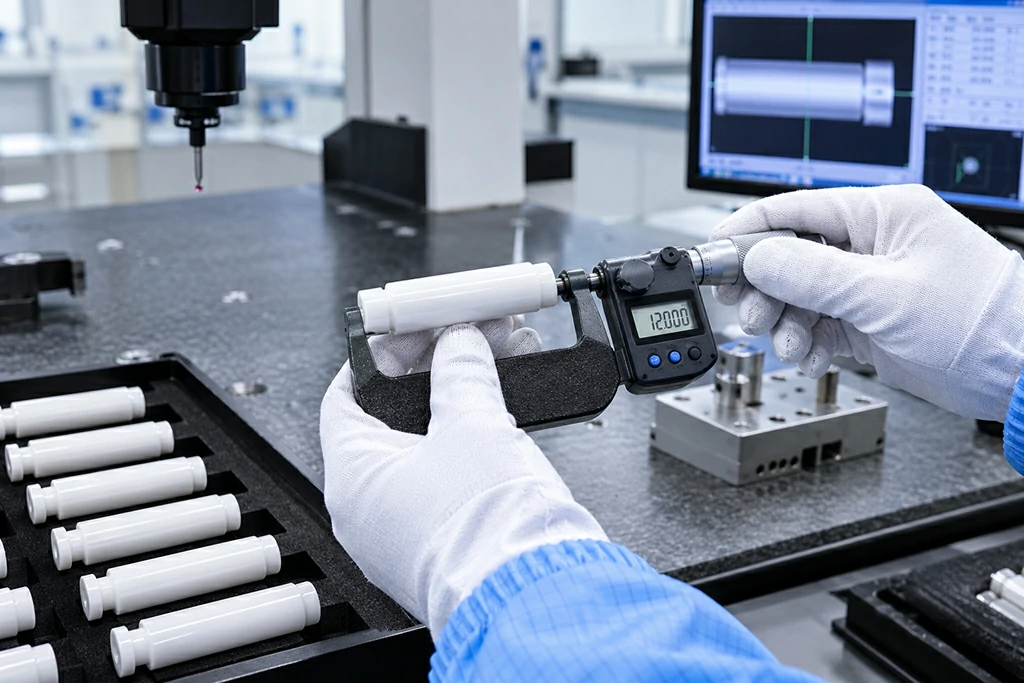
5. Material Properties Matrix (3Y-TZP, Mg-PSZ, Nano 3Y-TZP)
The table below summarizes the technical specifications of Vhandy zirconia ceramic grades (verified by international testing standards):
| Property Category | Item / Parameter | 3Y-TZP | Mg-PSZ | Nano 3Y-TZP | Eenheid |
|---|---|---|---|---|---|
| Mechanical | Kleur | Ivoor | White / Yellow | Blauw | - |
| Dichtheid | 6.02 | 5.70 | 6.01 | g/cm³ | |
| Buigsterkte | 800 | 550 | 1,200 | MPa | |
| Druksterkte | 3,000 | 2,500 | 3,000 | MPa | |
| Elastische modulus | 200 | 250 | 220 | GPa | |
| Breuktaaiheid | 8.0 | 6.0 ~ 7.0 | 14.0 | MPa·m1/2 | |
| Vickers hardheid | 1,200 | 1,100 | 1,200 | HV 0,5 | |
| Thermal | Thermal Expansion Coeff. | 10 | 10 | 10 | 10⁻⁶ K⁻¹ |
| Thermische geleidbaarheid | 3.0 | 3.0 | 2.0 | W/m·K | |
| Thermal Shock (Water) | 300 | 450 | 300 | ΔT °C | |
| Max Working Temp. | 1,000 | 2,100 | 1,000 | °C | |
| Electrical | Volume Resistance (20°C) | >10¹³ | >10¹⁴ | >10¹³ | Ω·cm |
| Diëlektrische sterkte | 11×10⁶ | 13×10⁵ | 11×10⁶ | V/m |
Precision Machining Standards
- Surface Flatness: Ra ≤ 0,1 μm
- Surface Finish: Ra ≤ 0,2 μm
- Dimensional Accuracy: Tolerance within tens of μm (up to ±0.002 mm)
- Aperture Precision: Diametertolerantie binnen een paar honderd μm
Q1: Can Vhandy provide samples for testing? How much does it cost?
Vhandy strives to provide ceramic samples that closely meet your requirements. Standard samples are completely free, but the customer pays the freight. For samples with unique shapes requiring custom molds, mold costs are open to transparent discussion.
Q2: We don't know which ceramic material we need, what should we do?
Please provide us with details about your operating conditions—such as intended application, working temperature, chemical contact, and desired properties. Our technical team will guide you in selecting the ideal ceramic grade (3Y-TZP, Nano 3Y-TZP, Mg-PSZ, or Alumina).
Q3: What are your trade terms and production lead times?
We prefer EXW, FOB, and C&F terms. Standard payment is T/T (30% deposit, 70% balance before delivery). Typical production lead time is 15 to 20 days.
Q4: How does Vhandy ensure product quality?
Vhandy maintains stringent quality control: ISO 9001 dimensional compliance (≥98.1%), ASTM C20 density (≥97%), ISO 6508 hardness (≥98.2%), ASTM C1161 flexural strength (≥97.9%), and ASTM C884 thermal shock stability (≥98.7%), complemented by SGS third-party testing.
Explore our range of alumina ceramics to discover how this versatile material can elevate your industrial processes.
Contact us: https://vhandy.com/contact-us/
 Dutch
 English
 Russian
 French
 Spanish
 Korean
 Arabic
 Vietnamese